
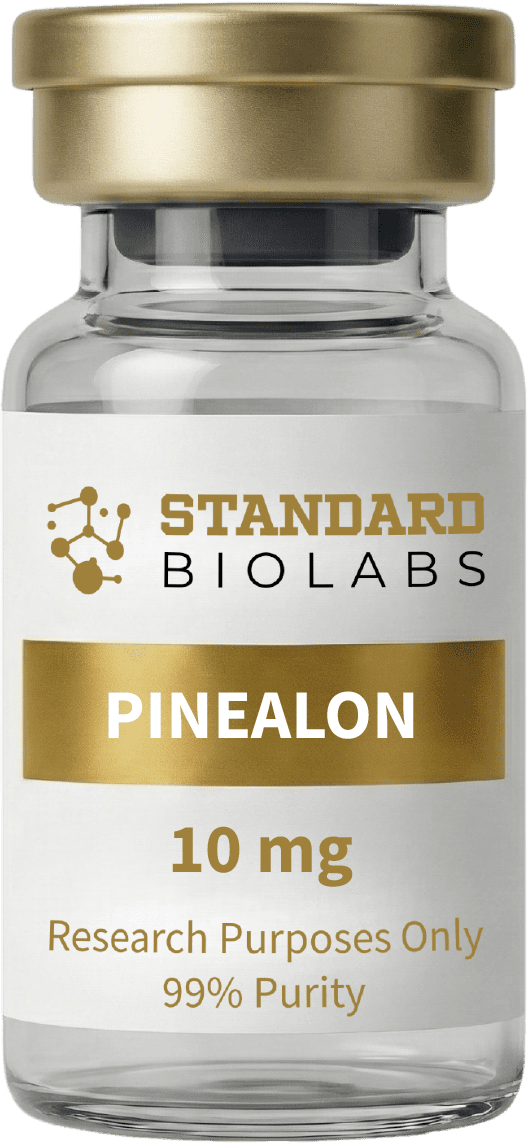
PINEALON 10mg
$
239 AUD
Product Info
Pinealon is a synthetic peptide research compound consisting of a short amino acid sequence (Glu-Asp-Arg) investigated for its potential neuroprotective and regulatory properties. It is commonly used in controlled laboratory studies to explore neuronal function, cellular signaling pathways, and tissue regeneration mechanisms. Pinealon is of interest for research into cognitive function, neuroprotection, and peptide-based modulation of cellular processes. This compound is supplied strictly for research purposes only and is not intended for human or veterinary use.
Buy 5 or more and save 10%
Categories
Bacteriostatic Water
AOD
Cagrilintide
Cagrilintide + Semaglutide
Retatrutide
Semaglutide
Tirzepatide
SLU PP 332
MOTS C
BPC 157
bpc-157-tb-500
Description
Overview
Biochemical Characteristics
Research Applications
Pathway / Mechanistic Context
Form & Analytical Testing
RUO Disclaimer


Overview
Biochemical Characteristics
Research Applications
Pathway / Mechanistic Context
Form & Analytical Testing
RUO Disclaimer
Overview
Pinealon is a synthetic tripeptide composed of three amino acids in a specific sequence: Glu-Asp-Arg (glutamic acid-aspartic acid-arginine). Originally isolated and characterized from bovine pineal gland extracts, Pinealon represents one of the most studied regulatory peptides derived from neuroendocrine tissue. This small molecular weight peptide (approximately 433 Da) has garnered significant research interest for its proposed role in circadian rhythm regulation, neuroendocrine modulation, and neuroprotection. Pinealon functions as a bioregulatory peptide that interacts with the pineal gland and broader neuroendocrine system, making it a valuable research tool for investigating aging-related neurobiological changes, sleep-wake cycle disruption, and age-associated cognitive decline. Its well-defined structure and potent biological activity at nanomolar concentrations have established it as a preferred model compound for studying peptide-based regulatory mechanisms in the central nervous system.
Overview
Pinealon is a synthetic tripeptide composed of three amino acids in a specific sequence: Glu-Asp-Arg (glutamic acid-aspartic acid-arginine). Originally isolated and characterized from bovine pineal gland extracts, Pinealon represents one of the most studied regulatory peptides derived from neuroendocrine tissue. This small molecular weight peptide (approximately 433 Da) has garnered significant research interest for its proposed role in circadian rhythm regulation, neuroendocrine modulation, and neuroprotection. Pinealon functions as a bioregulatory peptide that interacts with the pineal gland and broader neuroendocrine system, making it a valuable research tool for investigating aging-related neurobiological changes, sleep-wake cycle disruption, and age-associated cognitive decline. Its well-defined structure and potent biological activity at nanomolar concentrations have established it as a preferred model compound for studying peptide-based regulatory mechanisms in the central nervous system.
Biochemical Characteristics
Pinealon's tripeptide structure (H2N-Glu-Asp-Arg-COOH) confers several distinct biochemical advantages for research applications: Molecular weight: Approximately 433 Da, enabling excellent cell membrane permeability and blood-brain barrier penetration when administered systemically Charge distribution: The sequence contains acidic residues (glutamate and aspartate) and a basic residue (arginine), creating a zwitterionic character that facilitates both aqueous solubility and cellular uptake Chemical stability: The tripeptide backbone is highly stable under physiological pH and temperature conditions, resisting non-specific proteolysis better than larger peptides Receptor binding capacity: The specific amino acid composition enables selective interaction with putative pineal peptide receptors and G-protein coupled receptor systems Bioavailability: Unlike larger peptides, Pinealon's low molecular weight permits oral bioavailability in addition to parenteral routes, making it suitable for diverse research paradigms Conformational flexibility: The short peptide length allows dynamic conformational sampling, enhancing multi-target engagement within neural tissue The peptide demonstrates concentration-dependent activity in research models, with optimal effects typically observed at picomolar to nanomolar concentrations, indicating high biological potency.
Biochemical Characteristics
Pinealon's tripeptide structure (H2N-Glu-Asp-Arg-COOH) confers several distinct biochemical advantages for research applications: Molecular weight: Approximately 433 Da, enabling excellent cell membrane permeability and blood-brain barrier penetration when administered systemically Charge distribution: The sequence contains acidic residues (glutamate and aspartate) and a basic residue (arginine), creating a zwitterionic character that facilitates both aqueous solubility and cellular uptake Chemical stability: The tripeptide backbone is highly stable under physiological pH and temperature conditions, resisting non-specific proteolysis better than larger peptides Receptor binding capacity: The specific amino acid composition enables selective interaction with putative pineal peptide receptors and G-protein coupled receptor systems Bioavailability: Unlike larger peptides, Pinealon's low molecular weight permits oral bioavailability in addition to parenteral routes, making it suitable for diverse research paradigms Conformational flexibility: The short peptide length allows dynamic conformational sampling, enhancing multi-target engagement within neural tissue The peptide demonstrates concentration-dependent activity in research models, with optimal effects typically observed at picomolar to nanomolar concentrations, indicating high biological potency.
Research Applications
Pinealon is widely employed in neuroscience and gerontology research investigating: Circadian & Sleep Physiology Modulation of melatonin production and pineal gland function Regulation of sleep-wake cycle architecture and circadian rhythm entrainment Restoration of age-related circadian dysfunction and sleep fragmentation Investigation of chronobiological mechanisms underlying healthy aging Cognitive & Neuroprotection Enhancement of learning and memory consolidation in aging models Mitigation of age-related cognitive decline and mild cognitive impairment Neuroprotection against oxidative stress and excitotoxic insults Preservation of synaptic plasticity and neural network integrity in senescent neurons Neuroendocrine Regulation Modulation of pituitary-pineal axis function and hypothalamic-pituitary-adrenal (HPA) axis activity Regulation of hormone secretion patterns including melatonin, growth hormone, and cortisol Investigation of age-related endocrine dysregulation and hormonal decline Aging & Longevity Research Study of geroprotective mechanisms and healthspan extension Investigation of senescent cell behavior and age-associated inflammation Exploration of longevity pathways and aging biomarkers Immunological Function Enhancement of immune competence in aged organisms Modulation of T-cell and B-cell function age-related immune decline Investigation of immunosenescence reversal mechanisms
Research Applications
Pinealon is widely employed in neuroscience and gerontology research investigating: Circadian & Sleep Physiology Modulation of melatonin production and pineal gland function Regulation of sleep-wake cycle architecture and circadian rhythm entrainment Restoration of age-related circadian dysfunction and sleep fragmentation Investigation of chronobiological mechanisms underlying healthy aging Cognitive & Neuroprotection Enhancement of learning and memory consolidation in aging models Mitigation of age-related cognitive decline and mild cognitive impairment Neuroprotection against oxidative stress and excitotoxic insults Preservation of synaptic plasticity and neural network integrity in senescent neurons Neuroendocrine Regulation Modulation of pituitary-pineal axis function and hypothalamic-pituitary-adrenal (HPA) axis activity Regulation of hormone secretion patterns including melatonin, growth hormone, and cortisol Investigation of age-related endocrine dysregulation and hormonal decline Aging & Longevity Research Study of geroprotective mechanisms and healthspan extension Investigation of senescent cell behavior and age-associated inflammation Exploration of longevity pathways and aging biomarkers Immunological Function Enhancement of immune competence in aged organisms Modulation of T-cell and B-cell function age-related immune decline Investigation of immunosenescence reversal mechanisms
Pathway / Mechanistic Context
Pinealon is proposed to exert its biological effects through multiple integrated mechanisms acting at cellular, systems, and organismal levels: Pineal Gland Signaling Pinealon is thought to directly stimulate pinealocyte function through interaction with cell surface receptors, enhancing the synthesis and secretion of melatonin and other pineal peptide factors. This receptor-mediated activation restores age-related decline in pineal gland responsiveness and function. Antioxidant & Cytoprotective Mechanisms The peptide promotes upregulation of endogenous antioxidant defense systems, including superoxide dismutase (SOD), catalase, and glutathione peroxidase. This enhancement of free radical scavenging capacity reduces oxidative damage to neuronal mitochondria and prevents neuroinflammatory cascades initiated by oxidative stress. Neuroendocrine Integration Pinealon modulates hypothalamic-pituitary function, restoring age-appropriate patterns of growth hormone and luteinizing hormone (LH) secretion. By promoting coordinated neuroendocrine signaling, the peptide supports metabolic homeostasis and preservation of reproductive and somatic functions typically compromised during aging. Circadian Rhythm Restoration Through melatonin-dependent and melatonin-independent pathways, Pinealon enhances suprachiasmatic nucleus (SCN) sensitivity and peripheral clock resetting, restoring robust circadian oscillations and sleep architecture quality. This chronobiological normalization has cascading benefits for cognitive function, immune competence, and metabolic regulation. Mitochondrial Function & Metabolic Support The peptide enhances mitochondrial ATP production, improves mitochondrial membrane potential, and reduces age-related mitochondrial dysfunction. This metabolic enhancement provides increased energy availability for neural plasticity and synaptic transmission maintenance. Immune & Inflammatory Modulation Pinealon exhibits immunoenhancing properties by promoting Th1 cytokine production (IL-2, IFN-γ) while suppressing pro-inflammatory Th2 responses (TNF-α, IL-6). The peptide's anti-inflammatory effects reduce chronic low-grade inflammation ("inflammaging") characteristic of aging. Synaptic Plasticity & Neural Survival Through indirect activation of neurotrophic signaling and neuroprotective cascades, Pinealon preserves synaptic density, enhances long-term potentiation (LTP), and promotes neuronal survival in age-stressed neurons.
Pathway / Mechanistic Context
Pinealon is proposed to exert its biological effects through multiple integrated mechanisms acting at cellular, systems, and organismal levels: Pineal Gland Signaling Pinealon is thought to directly stimulate pinealocyte function through interaction with cell surface receptors, enhancing the synthesis and secretion of melatonin and other pineal peptide factors. This receptor-mediated activation restores age-related decline in pineal gland responsiveness and function. Antioxidant & Cytoprotective Mechanisms The peptide promotes upregulation of endogenous antioxidant defense systems, including superoxide dismutase (SOD), catalase, and glutathione peroxidase. This enhancement of free radical scavenging capacity reduces oxidative damage to neuronal mitochondria and prevents neuroinflammatory cascades initiated by oxidative stress. Neuroendocrine Integration Pinealon modulates hypothalamic-pituitary function, restoring age-appropriate patterns of growth hormone and luteinizing hormone (LH) secretion. By promoting coordinated neuroendocrine signaling, the peptide supports metabolic homeostasis and preservation of reproductive and somatic functions typically compromised during aging. Circadian Rhythm Restoration Through melatonin-dependent and melatonin-independent pathways, Pinealon enhances suprachiasmatic nucleus (SCN) sensitivity and peripheral clock resetting, restoring robust circadian oscillations and sleep architecture quality. This chronobiological normalization has cascading benefits for cognitive function, immune competence, and metabolic regulation. Mitochondrial Function & Metabolic Support The peptide enhances mitochondrial ATP production, improves mitochondrial membrane potential, and reduces age-related mitochondrial dysfunction. This metabolic enhancement provides increased energy availability for neural plasticity and synaptic transmission maintenance. Immune & Inflammatory Modulation Pinealon exhibits immunoenhancing properties by promoting Th1 cytokine production (IL-2, IFN-γ) while suppressing pro-inflammatory Th2 responses (TNF-α, IL-6). The peptide's anti-inflammatory effects reduce chronic low-grade inflammation ("inflammaging") characteristic of aging. Synaptic Plasticity & Neural Survival Through indirect activation of neurotrophic signaling and neuroprotective cascades, Pinealon preserves synaptic density, enhances long-term potentiation (LTP), and promotes neuronal survival in age-stressed neurons.
Preclinical Research Summary
Pinealon is typically supplied as pharmaceutical-grade powder or lyophilized preparation for research applications, with standard sterile aqueous solutions available at concentrations of 1–10 mg/mL: Physical Characterization Appearance: White to off-white crystalline or amorphous powder (if lyophilized); clear to slightly opalescent solution Molecular formula: C₁₆H₂₇N₅O₈ (MW: 433.41 g/mol) Solubility: Highly soluble in ultrapure water and physiological saline; stable across pH 4.0–8.5 Analytical Testing & Quality Control HPLC analysis: Verification of peptide purity (≥98% typically) with retention time confirmation and assessment of related peptide impurities Mass spectrometry (MS): Molecular ion confirmation (m/z 434) validating exact sequence and molecular weight Amino acid analysis: Quantitative determination of constituent glutamic acid, aspartic acid, and arginine residues Moisture content: Determination by Karl Fischer titration (typically <5% for lyophilized material) Endotoxin testing: LAL assay confirming acceptable pyrogenicity levels (<1 EU/mg) Microbial sterility: Compliance with USP/EP sterility requirements for injectable-grade material pH & osmolarity: Verification of physiological compatibility for biological applications Stability testing: Accelerated stability protocols confirming shelf-life under specified storage conditions (typically 24–36 months at 2–8°C) All analytical data is provided with Certificate of Analysis (CoA) documentation.
Preclinical Research Summary
Pinealon is typically supplied as pharmaceutical-grade powder or lyophilized preparation for research applications, with standard sterile aqueous solutions available at concentrations of 1–10 mg/mL: Physical Characterization Appearance: White to off-white crystalline or amorphous powder (if lyophilized); clear to slightly opalescent solution Molecular formula: C₁₆H₂₇N₅O₈ (MW: 433.41 g/mol) Solubility: Highly soluble in ultrapure water and physiological saline; stable across pH 4.0–8.5 Analytical Testing & Quality Control HPLC analysis: Verification of peptide purity (≥98% typically) with retention time confirmation and assessment of related peptide impurities Mass spectrometry (MS): Molecular ion confirmation (m/z 434) validating exact sequence and molecular weight Amino acid analysis: Quantitative determination of constituent glutamic acid, aspartic acid, and arginine residues Moisture content: Determination by Karl Fischer titration (typically <5% for lyophilized material) Endotoxin testing: LAL assay confirming acceptable pyrogenicity levels (<1 EU/mg) Microbial sterility: Compliance with USP/EP sterility requirements for injectable-grade material pH & osmolarity: Verification of physiological compatibility for biological applications Stability testing: Accelerated stability protocols confirming shelf-life under specified storage conditions (typically 24–36 months at 2–8°C) All analytical data is provided with Certificate of Analysis (CoA) documentation.
RUO Disclaimer
RESEARCH USE ONLY (RUO) This product is intended exclusively for laboratory research purposes and is not approved for clinical use, diagnostic procedures, therapeutic application, or human/animal administration outside of approved research protocols. Pinealon is provided for in vitro and in vivo research applications in qualified research facilities operating under appropriate institutional and regulatory oversight. This product is not manufactured, processed, tested, or validated for pharmaceutical, therapeutic, veterinary, or clinical use. The manufacturer and supplier make no claims regarding efficacy, safety, or suitability for any purpose other than research investigation. Users assume full responsibility for: Determining suitability of this product for their specific research applications Proper handling, storage, and transport according to applicable regulations Compliance with all institutional biosafety guidelines and protocols Compliance with local, state, and national regulations governing peptide research Appropriate institutional review and approval (IACUC, IRB, etc.) where applicable The information provided herein is for research reference only and does not constitute medical advice, therapeutic claims, or evidence of efficacy. Researchers must maintain awareness of current scientific literature and regulatory requirements governing peptide research in their jurisdiction.
RUO Disclaimer
RESEARCH USE ONLY (RUO) This product is intended exclusively for laboratory research purposes and is not approved for clinical use, diagnostic procedures, therapeutic application, or human/animal administration outside of approved research protocols. Pinealon is provided for in vitro and in vivo research applications in qualified research facilities operating under appropriate institutional and regulatory oversight. This product is not manufactured, processed, tested, or validated for pharmaceutical, therapeutic, veterinary, or clinical use. The manufacturer and supplier make no claims regarding efficacy, safety, or suitability for any purpose other than research investigation. Users assume full responsibility for: Determining suitability of this product for their specific research applications Proper handling, storage, and transport according to applicable regulations Compliance with all institutional biosafety guidelines and protocols Compliance with local, state, and national regulations governing peptide research Appropriate institutional review and approval (IACUC, IRB, etc.) where applicable The information provided herein is for research reference only and does not constitute medical advice, therapeutic claims, or evidence of efficacy. Researchers must maintain awareness of current scientific literature and regulatory requirements governing peptide research in their jurisdiction.

We are committed to supporting all research customers with consistent standards and professional care.

Subscribe
Subscribe to stay updated at every moment about all our news and product drops.
Terms of Service
Refund Policy
Privacy Policy
Promotional Terms

© Standard BioLabs. All rights reserved.
All products on this site are designated for Research Use Only and are supplied solely for laboratory, analytical, or scientific research purposes by qualified professionals. Products are not intended for human or animal use, and no diagnostic, therapeutic, or clinical use is intended or implied.
Standard BioLabs is a chemical supplier. Standard BioLabs is not a compounding pharmacy or chemical compounding facility as defined under 503A of the Federal Food, Drug, and Cosmetic Act. Standard BioLabs is not an outsourcing facility as defined under 503B of the Federal Food, Drug, and Cosmetic Act.
We are committed to supporting all research customers with consistent standards and professional care.
Subscribe
Subscribe to stay updated at every moment about all our news and product drops.
Terms of Service
Refund Policy
Privacy Policy
Promotional Terms
© Standard BioLabs. All rights reserved.
All products on this site are designated for Research Use Only and are supplied solely for laboratory, analytical, or scientific research purposes by qualified professionals. Products are not intended for human or animal use, and no diagnostic, therapeutic, or clinical use is intended or implied.
Standard BioLabs is a chemical supplier. Standard BioLabs is not a compounding pharmacy or chemical compounding facility as defined under 503A of the Federal Food, Drug, and Cosmetic Act. Standard BioLabs is not an outsourcing facility as defined under 503B of the Federal Food, Drug, and Cosmetic Act.
We are committed to supporting all research customers with consistent standards and professional care.
Subscribe
Subscribe to stay updated at every moment about all our news and product drops.
Terms of Service
Refund Policy
Privacy Policy
Promotional Terms
All products on this site are designated for Research Use Only and are supplied solely for laboratory, analytical, or scientific research purposes by qualified professionals. Products are not intended for human or animal use, and no diagnostic, therapeutic, or clinical use is intended or implied.
Standard BioLabs is a chemical supplier. Standard BioLabs is not a compounding pharmacy or chemical compounding facility as defined under 503A of the Federal Food, Drug, and Cosmetic Act. Standard BioLabs is not an outsourcing facility as defined under 503B of the Federal Food, Drug, and Cosmetic Act.
© Standard BioLabs. All rights reserved.