
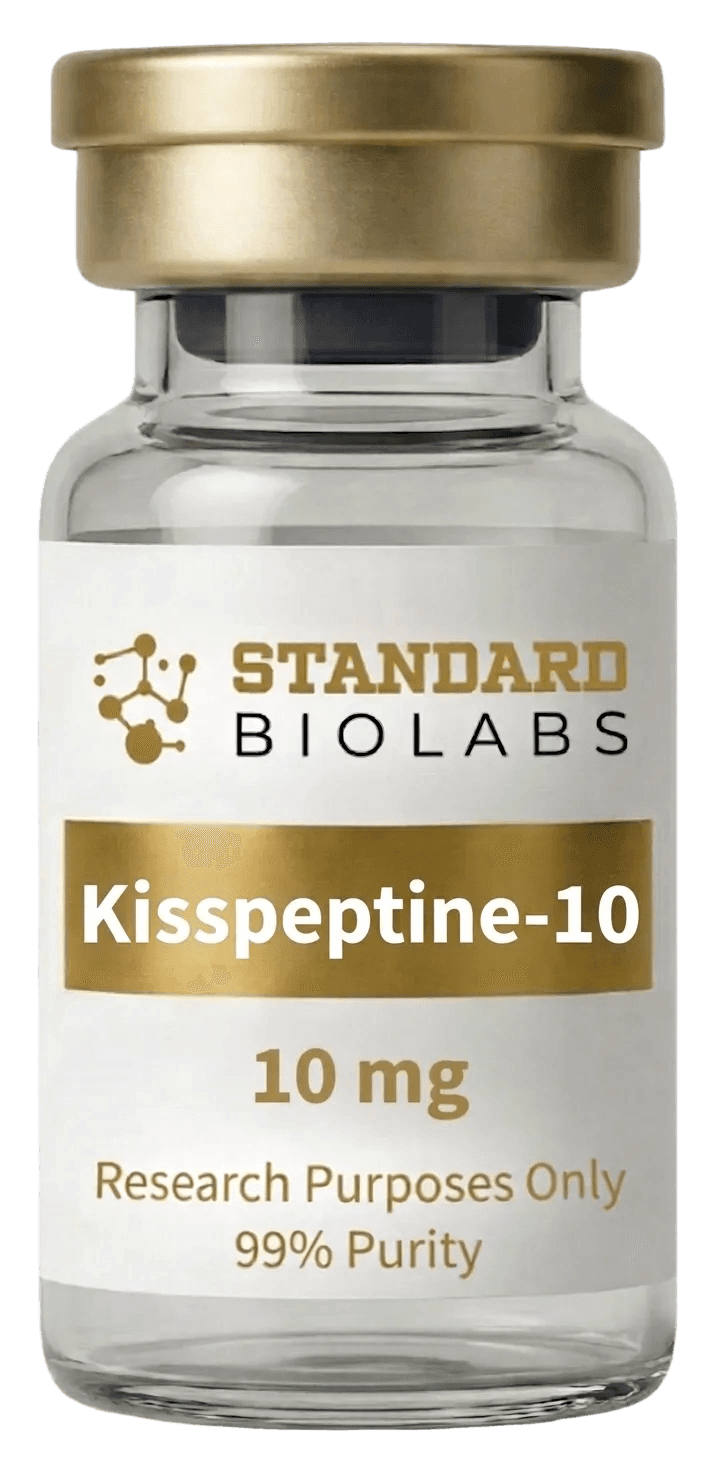
KISSPEPTIN-10
$
169 AUD
Product Info
Kisspeptin-10 is a synthetic peptide fragment of the naturally occurring kisspeptin protein, commonly used in laboratory research to study reproductive hormone regulation and neuroendocrine signalling. It is of interest in controlled experimental settings examining gonadotropin-releasing hormone (GnRH) pathways, puberty onset mechanisms, and peptide–receptor interactions. Kisspeptin-10 is supplied strictly for research purposes only and is not intended for human or veterinary use.
Buy 3 and save 15%
Buy 5 and save 20%
Categories
Bacteriostatic Water
AOD
Cagrilintide
Cagrilintide + Semaglutide
Retatrutide
Semaglutide
Tirzepatide
SLU PP 332
MOTS C
BPC 157
bpc-157-tb-500
Description
Overview
Biochemical Characteristics
Research Applications
Pathway / Mechanistic Context
Form & Analytical Testing
RUO Disclaimer


Overview
Biochemical Characteristics
Research Applications
Pathway / Mechanistic Context
Form & Analytical Testing
RUO Disclaimer
Overview
Kisspeptin-10 is a synthetic decapeptide derived from the kisspeptin protein family, a group of neuropeptides that regulate gonadotropin-releasing hormone (GnRH) secretion and reproductive function. The peptide activates Kiss1 receptors on GnRH neurons, serving as a critical gatekeeper of the reproductive axis. Kisspeptin-10 is extensively studied for its role in puberty initiation, sexual function, fertility, and gonadal hormone regulation. Research indicates the peptide directly stimulates GnRH release and enhances luteinizing hormone (LH) and follicle-stimulating hormone (FSH) secretion through hypothalamic-pituitary-gonadal (HPG) axis activation. Kisspeptin-10 represents a valuable research tool for investigating reproductive neurobiology, puberty mechanisms, and therapeutic approaches to fertility and reproductive disorders.
Overview
Kisspeptin-10 is a synthetic decapeptide derived from the kisspeptin protein family, a group of neuropeptides that regulate gonadotropin-releasing hormone (GnRH) secretion and reproductive function. The peptide activates Kiss1 receptors on GnRH neurons, serving as a critical gatekeeper of the reproductive axis. Kisspeptin-10 is extensively studied for its role in puberty initiation, sexual function, fertility, and gonadal hormone regulation. Research indicates the peptide directly stimulates GnRH release and enhances luteinizing hormone (LH) and follicle-stimulating hormone (FSH) secretion through hypothalamic-pituitary-gonadal (HPG) axis activation. Kisspeptin-10 represents a valuable research tool for investigating reproductive neurobiology, puberty mechanisms, and therapeutic approaches to fertility and reproductive disorders.
Biochemical Characteristics
Kisspeptin-10 is a 10-amino acid peptide with molecular weight of approximately 1,303 Da. The peptide is the minimal active form of the kisspeptin family, derived from the C-terminal region of the larger kisspeptin protein precursor. The peptide is water-soluble and demonstrates stability across physiological pH ranges (6.5–8.0). Kisspeptin-10 crosses the blood-brain barrier and localizes to hypothalamic regions containing GnRH neurons. The peptide exhibits moderate enzymatic resistance with biological half-life supporting reproductive signaling effects. Cellular uptake occurs through Kiss1 receptor binding and G-protein coupled receptor internalization. The peptide localizes to hypothalamic GnRH neurons and gonadotroph cells in the pituitary gland.
Biochemical Characteristics
Kisspeptin-10 is a 10-amino acid peptide with molecular weight of approximately 1,303 Da. The peptide is the minimal active form of the kisspeptin family, derived from the C-terminal region of the larger kisspeptin protein precursor. The peptide is water-soluble and demonstrates stability across physiological pH ranges (6.5–8.0). Kisspeptin-10 crosses the blood-brain barrier and localizes to hypothalamic regions containing GnRH neurons. The peptide exhibits moderate enzymatic resistance with biological half-life supporting reproductive signaling effects. Cellular uptake occurs through Kiss1 receptor binding and G-protein coupled receptor internalization. The peptide localizes to hypothalamic GnRH neurons and gonadotroph cells in the pituitary gland.
Research Applications
Puberty & Sexual Maturation Investigation of kisspeptin-10's role in puberty initiation and timing of reproductive maturation. GnRH & Gonadotropin Secretion Assessment of enhancement of gonadotropin-releasing hormone (GnRH) release and luteinizing hormone (LH)/follicle-stimulating hormone (FSH) production. Fertility & Reproduction Study of enhancement of male sexual function, sperm production, and female ovulatory cycles. Hypogonadism Models Investigation of potential therapeutic benefit in testosterone deficiency and reproductive hormone insufficiency. Amenorrhea & Anovulation Assessment of restoration of menstrual cycles and ovulation in hypothalamic dysfunction models. Sex Hormone Physiology Study of regulation of testosterone, estrogen, and progesterone production through HPG axis activation. Metabolic-Reproductive Coupling Investigation of integration of metabolic signals with reproductive function through kisspeptin neurons.
Research Applications
Puberty & Sexual Maturation Investigation of kisspeptin-10's role in puberty initiation and timing of reproductive maturation. GnRH & Gonadotropin Secretion Assessment of enhancement of gonadotropin-releasing hormone (GnRH) release and luteinizing hormone (LH)/follicle-stimulating hormone (FSH) production. Fertility & Reproduction Study of enhancement of male sexual function, sperm production, and female ovulatory cycles. Hypogonadism Models Investigation of potential therapeutic benefit in testosterone deficiency and reproductive hormone insufficiency. Amenorrhea & Anovulation Assessment of restoration of menstrual cycles and ovulation in hypothalamic dysfunction models. Sex Hormone Physiology Study of regulation of testosterone, estrogen, and progesterone production through HPG axis activation. Metabolic-Reproductive Coupling Investigation of integration of metabolic signals with reproductive function through kisspeptin neurons.
Pathway / Mechanistic Context
Kiss1 Receptor Activation Kisspeptin-10 binds and activates Kiss1 receptors (GPR54) on GnRH neurons in the hypothalamus, triggering calcium influx and depolarization of the GnRH neuron membrane. GnRH Neuron Excitation Kiss1 receptor activation directly stimulates GnRH neuronal firing frequency and promotes GnRH peptide synthesis and secretion into the hypothalamic-pituitary portal blood system. Gonadotropin Release GnRH released through kisspeptin-10 stimulation acts on gonadotroph cells in the anterior pituitary, promoting synthesis and secretion of luteinizing hormone (LH) and follicle-stimulating hormone (FSH). Testosterone & Estrogen Production LH stimulates testicular Leydig cells to enhance testosterone synthesis, while FSH and LH promote ovarian granulosa cell estrogen production in females. Metabolic Sensing Integration Kisspeptin neurons integrate metabolic signals from leptin, adiponectin, and energy status, coupling reproductive function to nutrient availability and body weight status. Puberty Gating Mechanism Developmental changes in kisspeptin neuron activity and Kiss1 receptor sensitivity mediate pubertal transition from childhood hypogonadism to adult reproductive competence.
Pathway / Mechanistic Context
Kiss1 Receptor Activation Kisspeptin-10 binds and activates Kiss1 receptors (GPR54) on GnRH neurons in the hypothalamus, triggering calcium influx and depolarization of the GnRH neuron membrane. GnRH Neuron Excitation Kiss1 receptor activation directly stimulates GnRH neuronal firing frequency and promotes GnRH peptide synthesis and secretion into the hypothalamic-pituitary portal blood system. Gonadotropin Release GnRH released through kisspeptin-10 stimulation acts on gonadotroph cells in the anterior pituitary, promoting synthesis and secretion of luteinizing hormone (LH) and follicle-stimulating hormone (FSH). Testosterone & Estrogen Production LH stimulates testicular Leydig cells to enhance testosterone synthesis, while FSH and LH promote ovarian granulosa cell estrogen production in females. Metabolic Sensing Integration Kisspeptin neurons integrate metabolic signals from leptin, adiponectin, and energy status, coupling reproductive function to nutrient availability and body weight status. Puberty Gating Mechanism Developmental changes in kisspeptin neuron activity and Kiss1 receptor sensitivity mediate pubertal transition from childhood hypogonadism to adult reproductive competence.
Preclinical Research Summary
Kisspeptin-10 is supplied as sterile aqueous solution or lyophilized powder at concentrations of 1–10 mg/mL. Storage at 2–8°C; shelf-life 12–24 months for solutions, 24–36 months for lyophilized material. Analytical testing includes HPLC purity verification (≥95%), HPLC-MS molecular confirmation, amino acid analysis, and microbial sterility/endotoxin testing. Bioassay verification of GnRH-stimulatory activity available upon request. Certificate of Analysis provided with each lot.
Preclinical Research Summary
Kisspeptin-10 is supplied as sterile aqueous solution or lyophilized powder at concentrations of 1–10 mg/mL. Storage at 2–8°C; shelf-life 12–24 months for solutions, 24–36 months for lyophilized material. Analytical testing includes HPLC purity verification (≥95%), HPLC-MS molecular confirmation, amino acid analysis, and microbial sterility/endotoxin testing. Bioassay verification of GnRH-stimulatory activity available upon request. Certificate of Analysis provided with each lot.
RUO Disclaimer
RESEARCH USE ONLY (RUO) This product is intended exclusively for laboratory research and is not approved for clinical use or human/animal administration. Not manufactured for pharmaceutical use. Users assume responsibility for suitability determination, proper storage, safety compliance, and regulatory adherence. Institutional approval (IACUC, IRB) may be required. Information provided is for research reference only and does not constitute medical advice or therapeutic claims.
RUO Disclaimer
RESEARCH USE ONLY (RUO) This product is intended exclusively for laboratory research and is not approved for clinical use or human/animal administration. Not manufactured for pharmaceutical use. Users assume responsibility for suitability determination, proper storage, safety compliance, and regulatory adherence. Institutional approval (IACUC, IRB) may be required. Information provided is for research reference only and does not constitute medical advice or therapeutic claims.

We are committed to supporting all research customers with consistent standards and professional care.

Subscribe
Subscribe to stay updated at every moment about all our news and product drops.
Terms of Service
Refund Policy
Privacy Policy
Promotional Terms

© Standard BioLabs. All rights reserved.
All products on this site are designated for Research Use Only and are supplied solely for laboratory, analytical, or scientific research purposes by qualified professionals. Products are not intended for human or animal use, and no diagnostic, therapeutic, or clinical use is intended or implied.
Standard BioLabs is a chemical supplier. Standard BioLabs is not a compounding pharmacy or chemical compounding facility as defined under 503A of the Federal Food, Drug, and Cosmetic Act. Standard BioLabs is not an outsourcing facility as defined under 503B of the Federal Food, Drug, and Cosmetic Act.
We are committed to supporting all research customers with consistent standards and professional care.
Subscribe
Subscribe to stay updated at every moment about all our news and product drops.
Terms of Service
Refund Policy
Privacy Policy
Promotional Terms
© Standard BioLabs. All rights reserved.
All products on this site are designated for Research Use Only and are supplied solely for laboratory, analytical, or scientific research purposes by qualified professionals. Products are not intended for human or animal use, and no diagnostic, therapeutic, or clinical use is intended or implied.
Standard BioLabs is a chemical supplier. Standard BioLabs is not a compounding pharmacy or chemical compounding facility as defined under 503A of the Federal Food, Drug, and Cosmetic Act. Standard BioLabs is not an outsourcing facility as defined under 503B of the Federal Food, Drug, and Cosmetic Act.
We are committed to supporting all research customers with consistent standards and professional care.
Subscribe
Subscribe to stay updated at every moment about all our news and product drops.
Terms of Service
Refund Policy
Privacy Policy
Promotional Terms
All products on this site are designated for Research Use Only and are supplied solely for laboratory, analytical, or scientific research purposes by qualified professionals. Products are not intended for human or animal use, and no diagnostic, therapeutic, or clinical use is intended or implied.
Standard BioLabs is a chemical supplier. Standard BioLabs is not a compounding pharmacy or chemical compounding facility as defined under 503A of the Federal Food, Drug, and Cosmetic Act. Standard BioLabs is not an outsourcing facility as defined under 503B of the Federal Food, Drug, and Cosmetic Act.
© Standard BioLabs. All rights reserved.