
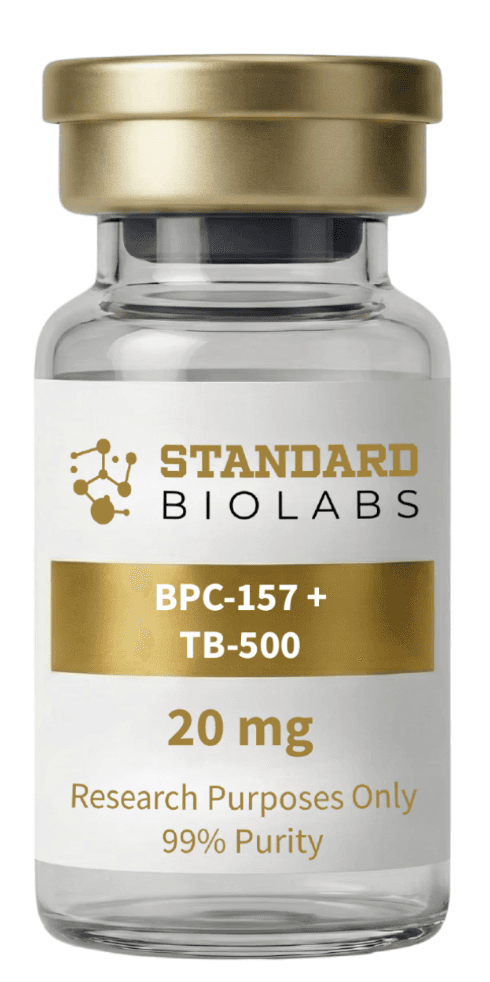
Wolverine
$
369 AUD
Product Info
BPC-157 + TB-500 is a combination of two synthetic peptides commonly used in laboratory research to study tissue repair, cellular migration, and regenerative processes. BPC-157 is derived from a naturally occurring body protection peptide, while TB-500 corresponds to a sequence of thymosin beta-4. Together, they are of interest in controlled experimental settings examining angiogenesis, inflammation, and cellular signalling pathways. This combination is supplied strictly for research purposes only and is not intended for human or veterinary use.
Buy 3 and save 15%
Buy 5 and save 20%
Categories
Bacteriostatic Water
AOD
Cagrilintide
Cagrilintide + Semaglutide
Retatrutide
Semaglutide
Tirzepatide
SLU PP 332
MOTS C
BPC 157
bpc-157-tb-500
Description
Overview
Biochemical Characteristics
Research Applications
Pathway / Mechanistic Context
Form & Analytical Testing
RUO Disclaimer


Overview
Biochemical Characteristics
Research Applications
Pathway / Mechanistic Context
Form & Analytical Testing
RUO Disclaimer
Overview
BPC-157 + TB-500 is a dual-peptide combination combining body protection compound-157 with thymosin beta-4 (TB-500) for synergistic tissue repair and regeneration effects. The combination targets complementary mechanisms in wound healing, tissue regeneration, and musculoskeletal recovery. This peptide combination is extensively studied for its enhanced potential in supporting accelerated healing, tissue regeneration, and functional recovery beyond monotherapy effects. Research indicates the dual peptide approach provides superior angiogenesis, collagen deposition, and tissue repair compared to either peptide alone. BPC-157 + TB-500 represents a valuable research tool for investigating synergistic tissue repair mechanisms, healing acceleration, and therapeutic approaches to injuries and tissue damage.
Overview
BPC-157 + TB-500 is a dual-peptide combination combining body protection compound-157 with thymosin beta-4 (TB-500) for synergistic tissue repair and regeneration effects. The combination targets complementary mechanisms in wound healing, tissue regeneration, and musculoskeletal recovery. This peptide combination is extensively studied for its enhanced potential in supporting accelerated healing, tissue regeneration, and functional recovery beyond monotherapy effects. Research indicates the dual peptide approach provides superior angiogenesis, collagen deposition, and tissue repair compared to either peptide alone. BPC-157 + TB-500 represents a valuable research tool for investigating synergistic tissue repair mechanisms, healing acceleration, and therapeutic approaches to injuries and tissue damage.
Biochemical Characteristics
BPC-157 is a 15-amino acid pentadecapeptide with molecular weight approximately 1,502 Da. TB-500 (thymosin beta-4) is a 43-amino acid peptide with molecular weight approximately 4,963 Da. Combined formulation enables simultaneous activation of complementary healing pathways and tissue regeneration mechanisms. Both peptides are water-soluble with stability across physiological pH ranges (6.5–8.0). BPC-157 exhibits remarkable enzymatic resistance and oral bioavailability. TB-500 demonstrates extended biological half-life and broad tissue distribution. The combination shows synergistic cellular uptake and complementary mechanistic effects. Cellular uptake occurs through peptide transporter mechanisms and direct receptor interactions on fibroblasts, endothelial cells, and immune cells involved in tissue repair.
Biochemical Characteristics
BPC-157 is a 15-amino acid pentadecapeptide with molecular weight approximately 1,502 Da. TB-500 (thymosin beta-4) is a 43-amino acid peptide with molecular weight approximately 4,963 Da. Combined formulation enables simultaneous activation of complementary healing pathways and tissue regeneration mechanisms. Both peptides are water-soluble with stability across physiological pH ranges (6.5–8.0). BPC-157 exhibits remarkable enzymatic resistance and oral bioavailability. TB-500 demonstrates extended biological half-life and broad tissue distribution. The combination shows synergistic cellular uptake and complementary mechanistic effects. Cellular uptake occurs through peptide transporter mechanisms and direct receptor interactions on fibroblasts, endothelial cells, and immune cells involved in tissue repair.
Research Applications
Wound Healing Acceleration Investigation of synergistic enhancement of wound closure and re-epithelialization rates. Tissue Regeneration Assessment of enhanced regeneration of skin, muscle, tendon, ligament, and connective tissues. Musculoskeletal Injury Recovery Study of accelerated recovery from muscle strain, tendon tear, and ligament damage models. Angiogenesis & Vascularization Investigation of enhanced new blood vessel formation and improved tissue perfusion. Collagen Synthesis & Deposition Assessment of increased collagen production and organized matrix deposition through complementary mechanisms. Inflammation Modulation Study of optimized inflammatory response through dual peptide anti-inflammatory and pro-repair effects. Fibrosis Prevention Investigation of reduction of excessive scar formation while promoting functional tissue regeneration.
Research Applications
Wound Healing Acceleration Investigation of synergistic enhancement of wound closure and re-epithelialization rates. Tissue Regeneration Assessment of enhanced regeneration of skin, muscle, tendon, ligament, and connective tissues. Musculoskeletal Injury Recovery Study of accelerated recovery from muscle strain, tendon tear, and ligament damage models. Angiogenesis & Vascularization Investigation of enhanced new blood vessel formation and improved tissue perfusion. Collagen Synthesis & Deposition Assessment of increased collagen production and organized matrix deposition through complementary mechanisms. Inflammation Modulation Study of optimized inflammatory response through dual peptide anti-inflammatory and pro-repair effects. Fibrosis Prevention Investigation of reduction of excessive scar formation while promoting functional tissue regeneration.
Pathway / Mechanistic Context
BPC-157 Tissue Protection BPC-157 activates growth factor signaling pathways including VEGF, HGF, and FGF, promoting angiogenesis, cell proliferation, and protective effects against apoptosis in damaged tissue. TB-500 Actin Modulation TB-500 binds and sequesters actin monomers, regulating cytoskeletal dynamics and promoting cellular motility, migration, and tissue remodeling essential for healing. Synergistic Angiogenesis BPC-157 and TB-500 provide complementary angiogenic signals—BPC-157 through direct growth factor activation and TB-500 through actin-dependent endothelial cell migration and tube formation. Fibroblast Activation & Proliferation Combined peptides enhance fibroblast proliferation and differentiation toward matrix-producing phenotype through complementary fibroblast growth factor and motility-enhancing mechanisms. Immune Cell Recruitment & Function BPC-157 and TB-500 modulate immune responses through enhancement of anti-inflammatory mediator production and recruitment of reparative immune cell populations. Organized Matrix Deposition The combination promotes deposition of organized, functional extracellular matrix through enhanced collagen synthesis, cross-linking, and alignment of matrix fibers.
Pathway / Mechanistic Context
BPC-157 Tissue Protection BPC-157 activates growth factor signaling pathways including VEGF, HGF, and FGF, promoting angiogenesis, cell proliferation, and protective effects against apoptosis in damaged tissue. TB-500 Actin Modulation TB-500 binds and sequesters actin monomers, regulating cytoskeletal dynamics and promoting cellular motility, migration, and tissue remodeling essential for healing. Synergistic Angiogenesis BPC-157 and TB-500 provide complementary angiogenic signals—BPC-157 through direct growth factor activation and TB-500 through actin-dependent endothelial cell migration and tube formation. Fibroblast Activation & Proliferation Combined peptides enhance fibroblast proliferation and differentiation toward matrix-producing phenotype through complementary fibroblast growth factor and motility-enhancing mechanisms. Immune Cell Recruitment & Function BPC-157 and TB-500 modulate immune responses through enhancement of anti-inflammatory mediator production and recruitment of reparative immune cell populations. Organized Matrix Deposition The combination promotes deposition of organized, functional extracellular matrix through enhanced collagen synthesis, cross-linking, and alignment of matrix fibers.
Preclinical Research Summary
BPC-157 + TB-500 is supplied as a dual-peptide formulation in sterile aqueous solution at concentrations of 1–10 mg/mL (combined peptide concentration). Storage at 2–8°C; shelf-life 12–24 months for solutions, 24–36 months for lyophilized material. Analytical testing includes HPLC separation and quantification of both BPC-157 and TB-500 with individual purity verification (≥95% each), HPLC-MS confirmation of both peptide identities, amino acid analysis of both components, and microbial sterility/endotoxin testing. Certificate of Analysis provided with each lot documenting individual peptide content and stability.
Preclinical Research Summary
BPC-157 + TB-500 is supplied as a dual-peptide formulation in sterile aqueous solution at concentrations of 1–10 mg/mL (combined peptide concentration). Storage at 2–8°C; shelf-life 12–24 months for solutions, 24–36 months for lyophilized material. Analytical testing includes HPLC separation and quantification of both BPC-157 and TB-500 with individual purity verification (≥95% each), HPLC-MS confirmation of both peptide identities, amino acid analysis of both components, and microbial sterility/endotoxin testing. Certificate of Analysis provided with each lot documenting individual peptide content and stability.
RUO Disclaimer
RESEARCH USE ONLY (RUO) This product is intended exclusively for laboratory research and is not approved for clinical use or human/animal administration. Not manufactured for pharmaceutical use. Users assume responsibility for suitability determination, proper storage, safety compliance, and regulatory adherence. Institutional approval (IACUC, IRB) may be required. Information provided is for research reference only and does not constitute medical advice or therapeutic claims.
RUO Disclaimer
RESEARCH USE ONLY (RUO) This product is intended exclusively for laboratory research and is not approved for clinical use or human/animal administration. Not manufactured for pharmaceutical use. Users assume responsibility for suitability determination, proper storage, safety compliance, and regulatory adherence. Institutional approval (IACUC, IRB) may be required. Information provided is for research reference only and does not constitute medical advice or therapeutic claims.

We are committed to supporting all research customers with consistent standards and professional care.

Subscribe
Subscribe to stay updated at every moment about all our news and product drops.
Terms of Service
Refund Policy
Privacy Policy
Promotional Terms

© Standard BioLabs. All rights reserved.
All products on this site are designated for Research Use Only and are supplied solely for laboratory, analytical, or scientific research purposes by qualified professionals. Products are not intended for human or animal use, and no diagnostic, therapeutic, or clinical use is intended or implied.
Standard BioLabs is a chemical supplier. Standard BioLabs is not a compounding pharmacy or chemical compounding facility as defined under 503A of the Federal Food, Drug, and Cosmetic Act. Standard BioLabs is not an outsourcing facility as defined under 503B of the Federal Food, Drug, and Cosmetic Act.
We are committed to supporting all research customers with consistent standards and professional care.
Subscribe
Subscribe to stay updated at every moment about all our news and product drops.
Terms of Service
Refund Policy
Privacy Policy
Promotional Terms
© Standard BioLabs. All rights reserved.
All products on this site are designated for Research Use Only and are supplied solely for laboratory, analytical, or scientific research purposes by qualified professionals. Products are not intended for human or animal use, and no diagnostic, therapeutic, or clinical use is intended or implied.
Standard BioLabs is a chemical supplier. Standard BioLabs is not a compounding pharmacy or chemical compounding facility as defined under 503A of the Federal Food, Drug, and Cosmetic Act. Standard BioLabs is not an outsourcing facility as defined under 503B of the Federal Food, Drug, and Cosmetic Act.
We are committed to supporting all research customers with consistent standards and professional care.
Subscribe
Subscribe to stay updated at every moment about all our news and product drops.
Terms of Service
Refund Policy
Privacy Policy
Promotional Terms
All products on this site are designated for Research Use Only and are supplied solely for laboratory, analytical, or scientific research purposes by qualified professionals. Products are not intended for human or animal use, and no diagnostic, therapeutic, or clinical use is intended or implied.
Standard BioLabs is a chemical supplier. Standard BioLabs is not a compounding pharmacy or chemical compounding facility as defined under 503A of the Federal Food, Drug, and Cosmetic Act. Standard BioLabs is not an outsourcing facility as defined under 503B of the Federal Food, Drug, and Cosmetic Act.
© Standard BioLabs. All rights reserved.