
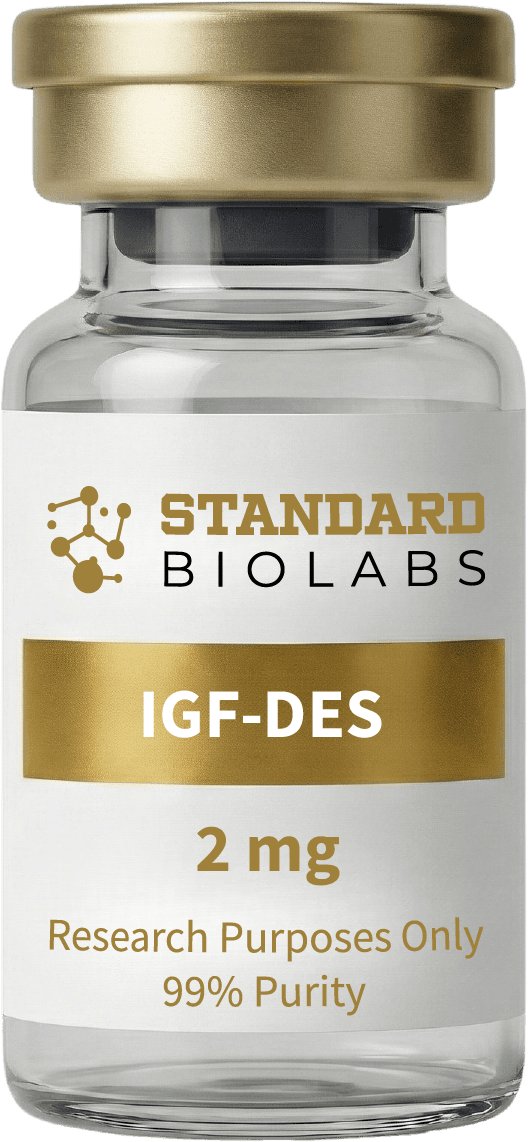
IGF-DES
$
199 AUD
Product Info
IGF-DES is a modified analogue of Insulin-Like Growth Factor-1 (IGF-1), commonly used in laboratory and biochemical research. It is structurally shortened compared to standard IGF-1, which alters its binding behaviour and makes it a subject of interest in studies related to cellular signalling, growth pathways, and receptor interaction. IGF-DES is typically utilised in controlled research environments to examine mechanisms of cell proliferation, differentiation, and metabolic regulation. This compound is supplied strictly for research purposes only and is not intended for human or veterinary use.
Buy 5 or more and save 10%
Categories
Bacteriostatic Water
AOD
Cagrilintide
Cagrilintide + Semaglutide
Retatrutide
Semaglutide
Tirzepatide
SLU PP 332
MOTS C
BPC 157
bpc-157-tb-500
Description
Overview
Biochemical Characteristics
Research Applications
Pathway / Mechanistic Context
Form & Analytical Testing
RUO Disclaimer


Overview
Biochemical Characteristics
Research Applications
Pathway / Mechanistic Context
Form & Analytical Testing
RUO Disclaimer
Overview
IGF-DES (insulin-like growth factor 1 des(1-3)) is a truncated form of insulin-like growth factor 1 (IGF-1) lacking the first three N-terminal amino acids. The peptide functions as a potent growth factor activating IGF-1 receptor signaling with enhanced metabolic bioavailability and reduced IGF-1 binding protein (IGFBP) sequestration. IGF-DES is extensively studied for its potential in supporting muscle growth, tissue regeneration, metabolic function, and recovery from injury. Research indicates the peptide activates IGF-1 receptor signaling pathways, promoting anabolic effects through mechanisms similar to full-length IGF-1 while exhibiting improved cellular bioavailability and reduced binding protein interference. IGF-DES represents a valuable research tool for investigating IGF-1 receptor biology, anabolic signaling, tissue repair mechanisms, and therapeutic approaches to muscle wasting and tissue dysfunction.
Overview
IGF-DES (insulin-like growth factor 1 des(1-3)) is a truncated form of insulin-like growth factor 1 (IGF-1) lacking the first three N-terminal amino acids. The peptide functions as a potent growth factor activating IGF-1 receptor signaling with enhanced metabolic bioavailability and reduced IGF-1 binding protein (IGFBP) sequestration. IGF-DES is extensively studied for its potential in supporting muscle growth, tissue regeneration, metabolic function, and recovery from injury. Research indicates the peptide activates IGF-1 receptor signaling pathways, promoting anabolic effects through mechanisms similar to full-length IGF-1 while exhibiting improved cellular bioavailability and reduced binding protein interference. IGF-DES represents a valuable research tool for investigating IGF-1 receptor biology, anabolic signaling, tissue repair mechanisms, and therapeutic approaches to muscle wasting and tissue dysfunction.
Biochemical Characteristics
IGF-DES is a 67-amino acid peptide with molecular weight of approximately 7,294 Da. The peptide is the des(1-3) truncation of insulin-like growth factor 1, lacking the three N-terminal amino acids (Gly-Pro-Glu) of full-length IGF-1. The peptide is water-soluble and demonstrates stability across physiological pH ranges (6.5–8.0). IGF-DES exhibits reduced affinity for IGF-1 binding proteins (IGFBPs), particularly IGFBP-3 and IGFBP-5, enabling greater free peptide availability and enhanced bioactivity at target tissues. Cellular uptake occurs through IGF-1 receptor binding and internalization on muscle, adipose, hepatic, and neural tissues where anabolic and growth-promoting effects are exerted.
Biochemical Characteristics
IGF-DES is a 67-amino acid peptide with molecular weight of approximately 7,294 Da. The peptide is the des(1-3) truncation of insulin-like growth factor 1, lacking the three N-terminal amino acids (Gly-Pro-Glu) of full-length IGF-1. The peptide is water-soluble and demonstrates stability across physiological pH ranges (6.5–8.0). IGF-DES exhibits reduced affinity for IGF-1 binding proteins (IGFBPs), particularly IGFBP-3 and IGFBP-5, enabling greater free peptide availability and enhanced bioactivity at target tissues. Cellular uptake occurs through IGF-1 receptor binding and internalization on muscle, adipose, hepatic, and neural tissues where anabolic and growth-promoting effects are exerted.
Research Applications
Muscle Growth & Hypertrophy Investigation of IGF-DES-induced enhancement of skeletal muscle protein synthesis and lean mass development. Anabolic Signaling Assessment of IGF-1 receptor pathway activation and downstream signaling including mTOR and PI3K/Akt cascades. Tissue Regeneration Study of enhanced regeneration of muscle, connective tissue, and other damaged tissues following injury. Metabolic Function Investigation of improvements in glucose metabolism, insulin sensitivity, and metabolic rate. Recovery from Injury Assessment of accelerated recovery and functional restoration following musculoskeletal injury. Bone Health & Density Study of enhancement of bone remodeling and support for bone mineral density maintenance. Lipolysis & Fat Reduction Investigation of enhanced fat mobilization and reduction in adiposity through metabolic effects.
Research Applications
Muscle Growth & Hypertrophy Investigation of IGF-DES-induced enhancement of skeletal muscle protein synthesis and lean mass development. Anabolic Signaling Assessment of IGF-1 receptor pathway activation and downstream signaling including mTOR and PI3K/Akt cascades. Tissue Regeneration Study of enhanced regeneration of muscle, connective tissue, and other damaged tissues following injury. Metabolic Function Investigation of improvements in glucose metabolism, insulin sensitivity, and metabolic rate. Recovery from Injury Assessment of accelerated recovery and functional restoration following musculoskeletal injury. Bone Health & Density Study of enhancement of bone remodeling and support for bone mineral density maintenance. Lipolysis & Fat Reduction Investigation of enhanced fat mobilization and reduction in adiposity through metabolic effects.
Pathway / Mechanistic Context
IGF-1 Receptor Activation IGF-DES binds and activates IGF-1 receptors on target cells, triggering autophosphorylation and activation of intracellular signaling cascades including PI3K/Akt and MAPK/ERK pathways. mTOR Pathway Enhancement IGF-DES activates mammalian target of rapamycin (mTOR) signaling through Akt-dependent mechanisms, promoting protein synthesis through S6K and 4E-BP1 activation. Reduced IGFBP Sequestration The des(1-3) truncation reduces affinity for IGF-1 binding proteins (IGFBPs), particularly IGFBP-3 and IGFBP-5, enabling greater free peptide bioavailability and enhanced IGF-1 receptor occupancy. Metabolic Flexibility Enhancement IGF-DES promotes metabolic switching between glucose and lipid oxidation through activation of AKT-dependent metabolic pathways and enhancement of mitochondrial oxidative capacity. Myogenic Differentiation The peptide promotes satellite cell differentiation toward myogenic lineage and fusion with existing myofibers through IGF-1 receptor-dependent signaling. Lipolytic Activation IGF-DES enhances fat mobilization and lipolysis through hormone-sensitive lipase activation and promotion of adipose tissue oxidative metabolism.
Pathway / Mechanistic Context
IGF-1 Receptor Activation IGF-DES binds and activates IGF-1 receptors on target cells, triggering autophosphorylation and activation of intracellular signaling cascades including PI3K/Akt and MAPK/ERK pathways. mTOR Pathway Enhancement IGF-DES activates mammalian target of rapamycin (mTOR) signaling through Akt-dependent mechanisms, promoting protein synthesis through S6K and 4E-BP1 activation. Reduced IGFBP Sequestration The des(1-3) truncation reduces affinity for IGF-1 binding proteins (IGFBPs), particularly IGFBP-3 and IGFBP-5, enabling greater free peptide bioavailability and enhanced IGF-1 receptor occupancy. Metabolic Flexibility Enhancement IGF-DES promotes metabolic switching between glucose and lipid oxidation through activation of AKT-dependent metabolic pathways and enhancement of mitochondrial oxidative capacity. Myogenic Differentiation The peptide promotes satellite cell differentiation toward myogenic lineage and fusion with existing myofibers through IGF-1 receptor-dependent signaling. Lipolytic Activation IGF-DES enhances fat mobilization and lipolysis through hormone-sensitive lipase activation and promotion of adipose tissue oxidative metabolism.
Preclinical Research Summary
IGF-DES is supplied as sterile aqueous solution or lyophilized powder at concentrations of 1–10 mg/mL. Storage at 2–8°C; shelf-life 12–24 months for solutions, 24–36 months for lyophilized material. Analytical testing includes HPLC purity verification (≥95%), HPLC-MS molecular confirmation with des(1-3) truncation verification, amino acid analysis, and microbial sterility/endotoxin testing. Bioassay verification of IGF-1 receptor activation and anabolic signaling available upon request. Certificate of Analysis provided with each lot.
Preclinical Research Summary
IGF-DES is supplied as sterile aqueous solution or lyophilized powder at concentrations of 1–10 mg/mL. Storage at 2–8°C; shelf-life 12–24 months for solutions, 24–36 months for lyophilized material. Analytical testing includes HPLC purity verification (≥95%), HPLC-MS molecular confirmation with des(1-3) truncation verification, amino acid analysis, and microbial sterility/endotoxin testing. Bioassay verification of IGF-1 receptor activation and anabolic signaling available upon request. Certificate of Analysis provided with each lot.
RUO Disclaimer
RESEARCH USE ONLY (RUO) This product is intended exclusively for laboratory research and is not approved for clinical use or human/animal administration. Not manufactured for pharmaceutical use. Users assume responsibility for suitability determination, proper storage, safety compliance, and regulatory adherence. Institutional approval (IACUC, IRB) may be required. Information provided is for research reference only and does not constitute medical advice or therapeutic claims.
RUO Disclaimer
RESEARCH USE ONLY (RUO) This product is intended exclusively for laboratory research and is not approved for clinical use or human/animal administration. Not manufactured for pharmaceutical use. Users assume responsibility for suitability determination, proper storage, safety compliance, and regulatory adherence. Institutional approval (IACUC, IRB) may be required. Information provided is for research reference only and does not constitute medical advice or therapeutic claims.

We are committed to supporting all research customers with consistent standards and professional care.

Subscribe
Subscribe to stay updated at every moment about all our news and product drops.
Terms of Service
Refund Policy
Privacy Policy
Promotional Terms

© Standard BioLabs. All rights reserved.
All products on this site are designated for Research Use Only and are supplied solely for laboratory, analytical, or scientific research purposes by qualified professionals. Products are not intended for human or animal use, and no diagnostic, therapeutic, or clinical use is intended or implied.
Standard BioLabs is a chemical supplier. Standard BioLabs is not a compounding pharmacy or chemical compounding facility as defined under 503A of the Federal Food, Drug, and Cosmetic Act. Standard BioLabs is not an outsourcing facility as defined under 503B of the Federal Food, Drug, and Cosmetic Act.
We are committed to supporting all research customers with consistent standards and professional care.
Subscribe
Subscribe to stay updated at every moment about all our news and product drops.
Terms of Service
Refund Policy
Privacy Policy
Promotional Terms
© Standard BioLabs. All rights reserved.
All products on this site are designated for Research Use Only and are supplied solely for laboratory, analytical, or scientific research purposes by qualified professionals. Products are not intended for human or animal use, and no diagnostic, therapeutic, or clinical use is intended or implied.
Standard BioLabs is a chemical supplier. Standard BioLabs is not a compounding pharmacy or chemical compounding facility as defined under 503A of the Federal Food, Drug, and Cosmetic Act. Standard BioLabs is not an outsourcing facility as defined under 503B of the Federal Food, Drug, and Cosmetic Act.
We are committed to supporting all research customers with consistent standards and professional care.
Subscribe
Subscribe to stay updated at every moment about all our news and product drops.
Terms of Service
Refund Policy
Privacy Policy
Promotional Terms
All products on this site are designated for Research Use Only and are supplied solely for laboratory, analytical, or scientific research purposes by qualified professionals. Products are not intended for human or animal use, and no diagnostic, therapeutic, or clinical use is intended or implied.
Standard BioLabs is a chemical supplier. Standard BioLabs is not a compounding pharmacy or chemical compounding facility as defined under 503A of the Federal Food, Drug, and Cosmetic Act. Standard BioLabs is not an outsourcing facility as defined under 503B of the Federal Food, Drug, and Cosmetic Act.
© Standard BioLabs. All rights reserved.